Everything we experience in relation to the physical world brings us pain. Buddhist teaching says all suffering is caused by our attachments. If we consider this deeply we come to see that these attachments, be it food, money or relationships, are essentially emotional and mental attachments we have created to add value and meaning to our lives.
Watch your thoughts change from pleasure to pain
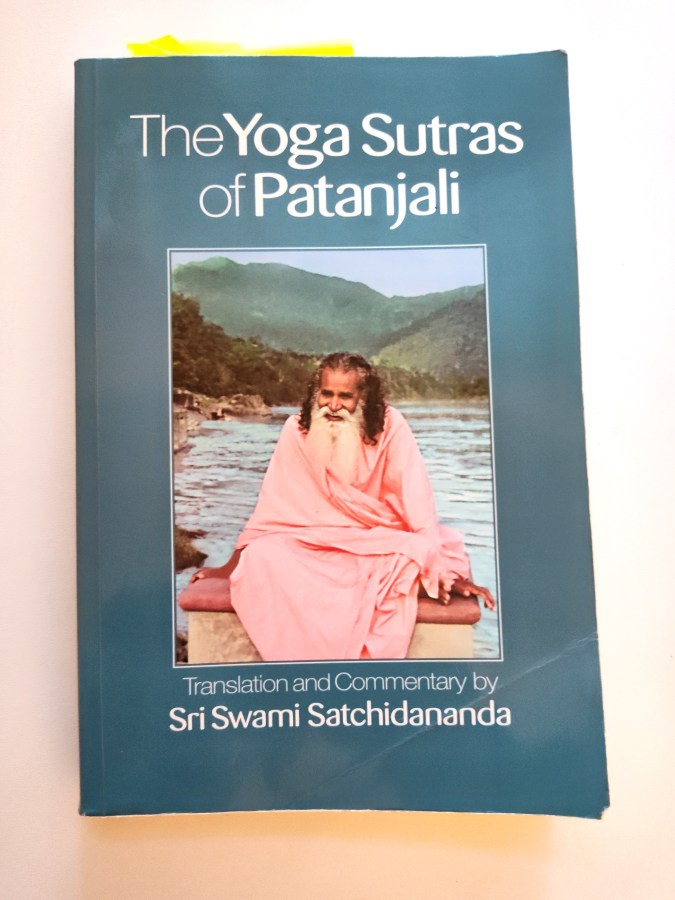
In The Yoga Sutras of Patanjali Sri Swami Satchidananda makes an excellent point that even in pleasure there is pain because once we acquire the thing or experience that brings us pleasure, fear and anxiety over losing it comes simultaneously. This constant push and pull of fear and pleasure fuels desire. This is why we are never satisfied with what we have and can rarely ever truly relax into the joy and acceptance of what is in the present moment.
Try this exercise to see how your thoughts determine feelings of pleasure or pain: Close your eyes and think of someone or something that brings you a lot of joy. Some examples could be your children, a partner, your favorite hobby or place to visit. Hold that person or thing in your mind for as long as possible. What happens? Do any negative thoughts begin to arise? Any fears surrounding loss? When you are ready, take a deep breath in through your nose and slowly release it out through your mouth allowing your whole body to relax as you exhale. What did you discover the longer you held onto the attachment you felt with this person or thing?
Release your grip on expectations of pleasure or pain
If we can begin to release our grip on expectations about how everyone and everything must play out, including ourselves, as well as learn to observe our thoughts when we experience pleasure or pain, we can become more empowered about our reactions to the life that is unfolding before us.
This release or detachment is referred to as non-attachment in the yoga sutras.
Non-attachment should not be misunderstood to be indifference. Vairāgya (non-attachment) literally means “colorless.” Vi is “without,” rāga is “color.” Every desire brings its own color to the mind. The moment you color the mind, a ripple is formed – just as when a stone is thrown into a calm lake, it creates waves in the water.
Try this exercise to discover how much your expectations rule your level of happiness: Put the name of someone you know fairly well at the top of a page. This could be a family member, a friend or a co-worker. Now make a list of everything you expect from them. For example, do you expect them to always remember your birthday, say hello to you in the morning, reciprocate a kind gesture? Which of these actions or behaviors can you actually control? Have you ever had a negative thought or reaction when they didn’t do what you expected? We throw around positive affirmations and slogans like ‘be kind’ but does true kindness expect anything in return?
Fear of loss removes us from being present
At the crux of our pain is the fear of loss. The fear that somehow we will lose ourselves once we become detached from that thing or person. In Yoga philosophy there is the SEER and the SEEN. The ‘I’ that experiences an event and the the ‘I’ that observes the event occurring. We say ‘my this’ or ‘my that,’ but who is the one claiming possession? Who is the one that notices our perceptions? A certain level of detachment is required to be able to observe yourself as the seer and the seen. This doesn’t mean you should switch off your emotions but instead realize that they are reactions to the perception you have of yourself and the situation. Loss is an inevitable part of life, but we can learn to be present with it.
Try this to discover how you manage feelings of loss: The next time you feel disappointed consider what it is that you have lost. Be specific.
Was it recognition for a job well done? Intimacy with a loved one? A missed opportunity for an exciting adventure? Don’t be in such a hurry to dismiss your feelings, they will tell you what you value most in the world.
Our observation of the experience of loss and fear of it can bring us into deeper awareness of our attachment to things outside of ourselves that we have no control over. Just as our thoughts come and go in every moment, so too do our experiences of pleasure and pain. If we meet them in the moment with our awareness and non-attachment, we can begin to transcend the suffering that arises in between.
Sri Swami Satchidananda was a pioneering Yoga guru who introduced the Yoga tradition to the West in the 1960s through establishing ashrams, yoga teacher training programs and the first yoga magazine in the USA. He led around half a million Americans in chanting “OM” at the 1969 Woodstock Music and Art Festival and thus became known as the “Woodstock Guru.”
Cover image by Sasha Freemind

 CHERONE BELLINFANTIE
Leave a comment